
Success is to be measured not so much by the position that one has reached in life as by the obstacles which he has overcome.” – Booker T. Washington
Let’s talk numbers for a second.
Real numbers.
The kind nobody puts on a motivational poster.
You can work hard, show up every day, do everything you’re supposed to do, and still feel like you’re getting nowhere financially.
That’s the part nobody likes to talk about.
You get up.
You go to work.
You pay the bills.
You buy groceries.
You fill the car.
You deal with insurance, subscriptions, repairs, unexpected expenses and everything else life throws at you.
And then you do it all again next week.
Maybe you even work overtime.
Maybe you take on a second job.
Yet somehow, you can still feel one unexpected bill away from being in trouble.
So what’s going on?
Working harder isn’t always the answer
There is nothing wrong with working hard.
The problem is that hard work and wealth are not necessarily the same thing.
A paycheck generally pays you for the time you give to someone else.
If you work 40 hours, you get paid for those hours.
If you work 50 hours, you generally get paid for those extra hours.
But there is a limit.
You only have so many hours in a day, and you can only sell the same hour once.
That creates a ceiling.
And when the cost of living keeps increasing, simply working more hours may not solve the underlying problem.
The question becomes:
What are you building that can continue working after today’s work is finished?
That is a very different question.
Your biggest problem might be the model, not your work ethic
This is where things get interesting.
A lot of people assume that if they aren’t getting ahead, they simply need to work harder.
But what if the real issue is the model they’re using?
Think about an employee.
They can become better at their job.
They can take on more responsibility.
They can negotiate a raise.
All of those things can help.
But their income is still largely connected to their employment.
An online business works differently.
Instead of only being paid for hours worked, you can start building assets.
An email list is one example.
A useful piece of content can continue attracting people after you publish it.
A relationship with a subscriber can continue over time.
A properly structured follow-up sequence can continue communicating with people when you’re not sitting at your computer.
That doesn’t mean it’s effortless.
It isn’t.
But the goal is different.
You’re not simply trying to make another dollar today.
You’re trying to build something that has value tomorrow.
The asset most beginners overlook
This is one of the biggest shifts in thinking for anyone getting started with affiliate marketing.
Most people think about traffic first.
They ask:
“How do I get people to click my link?”
That’s understandable.
But there’s a problem.
If someone clicks your affiliate link and leaves, what do you have?
Possibly nothing.
You’ve generated the click, but you haven’t necessarily kept the relationship.
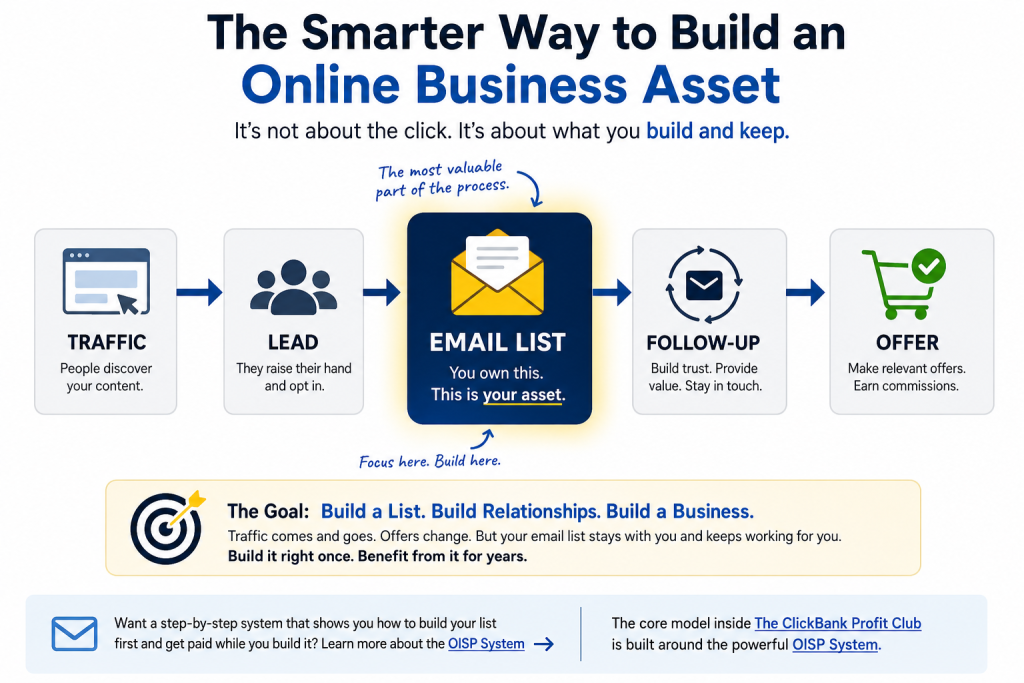
That’s why the idea of building your list first matters.
Instead of sending people straight to an affiliate offer, you can focus on capturing the lead and continuing the conversation.
The list becomes an asset.
And follow-up becomes an important part of the process.
As the old saying goes, the money is often in the follow-up.
The exact mechanics matter, but the bigger lesson is simple:
Don’t just chase the click. Build something you can keep.
What if you could build the list while promoting an offer?
This is one of the ideas that caught my attention.
There is a much cleaner way to approach affiliate marketing than constantly finding new people, sending them to an offer and starting from zero the next day.
The idea is to build your email list while you’re working toward commissions.
That changes the way you think about traffic.
One visitor isn’t just a potential click.
They’re potentially a lead.
One lead isn’t just a possible sale.
They’re someone you can continue to communicate with.
And that creates a much more long-term way of looking at online business.
It’s not about finding some magical shortcut.
It’s about putting the pieces in a better order.
You don’t have to build everything from scratch
Here’s another reason beginners often get stuck.
They think starting an online business means building everything themselves.
Website.
Products.
Funnels.
Email systems.
Support.
Technology.
Content.
Traffic.
And about 47 other things they’ve never heard of.
No wonder people get overwhelmed.
A simpler model can remove some of that complexity.
The ClickBank Profit Club is built around affiliate marketing, list building, follow-up and commissions, with the aim of giving beginners and stuck affiliates a clearer starting point.
Members don’t have to create their own products or put every technical piece together themselves.
The training also covers areas such as affiliate marketing, email marketing, content creation, social media promotion, funnel thinking and AI for content and workflow.
And importantly, the model keeps coming back to the same core idea:
Build your list. Follow up. Build an asset.
That’s a much easier concept to understand than trying to learn every online marketing tactic at once.
A different definition of working hard
Maybe the answer isn’t to stop working hard.
Maybe it’s to make sure some of that hard work is actually building something for you.
There’s a big difference between being busy and making progress.
You can spend months jumping between platforms, watching tutorials, buying another course, trying another traffic method and starting another project.
Or you can step back and ask:
What am I actually building?
If the answer is “nothing I can keep,” that might be worth reconsidering.
Because traffic comes and goes.
Platforms change.
Algorithms change.
Offers change.
But an email list you’ve built and the relationships you’ve developed with those subscribers can become a longer-term business asset.
That’s why list building is such an important part of the model.
The breakthrough is often simpler than you think
For someone who’s been struggling online, the breakthrough isn’t always another tactic.
Sometimes it’s realizing that the order was wrong.
Instead of:
Find traffic → send traffic to an offer → hope someone buys
the thinking becomes:
Find people → capture the lead → build the relationship → follow up → promote relevant offers
That’s a very different approach.
And it gives you something to build rather than simply something to promote.
If you’ve tried affiliate marketing before and felt like you were constantly starting over, this is worth understanding.
The OLSP System is designed around that simpler approach, particularly for beginners, people who have tried before and affiliates who are getting clicks but not making sales.
You still have to put in the work.
You still have to learn.
You still have to create content, attract people and follow up.
But at least the work can be moving toward building an asset.
And that may be the bigger financial lesson.
Working hard matters.
But working hard on the wrong thing can keep you busy without moving you forward.
So perhaps the better question isn’t:
“Am I working hard enough?”
It’s:
“Am I building something that can become more valuable over time?”
That’s a question worth asking.
Want to see the model?
If you’re curious about a simpler, beginner-friendly approach to affiliate marketing, list building and follow-up, you can take a closer look at The ClickBank Profit Club.
No hype.
Just a different way of thinking about what you’re building.