
“Education is the most powerful weapon which you can use to change the world.” Nelson Mandela.
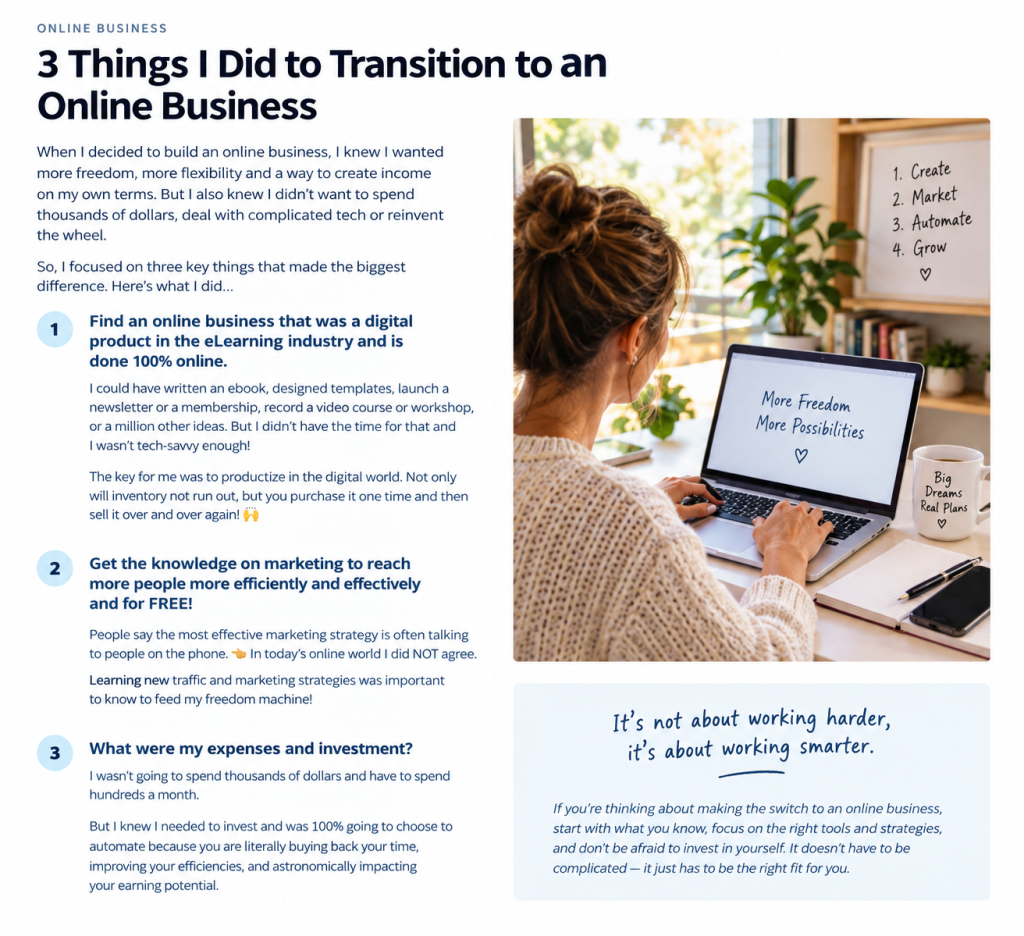
3 Things I Did to Transition to an Online Business
Making the move to an online business was something I wanted to do, but I knew I needed to approach it the right way.
I wanted more freedom, more flexibility, and the opportunity to build something of my own.
But there were a few things holding me back.
I didn’t have the time to create a product from scratch. I wasn’t particularly tech-savvy, and I certainly wasn’t looking to spend thousands of dollars just to get started.
I knew there had to be a more practical way to approach it.
Looking back, there were three things that really shaped my decision. take a closer look here.
1. I looked for a digital product business that could run entirely online
This was my starting point.
I wanted something in the eLearning industry, where the product could be delivered digitally and the business could operate online.
Of course, I could have created my own e book, designed templates, launched a membership, started a newsletter, or recorded a video course.
There are so many possibilities when it comes to digital products.
The problem was that creating everything myself would take time, knowledge, and skills I didn’t yet have.
I needed a way to get involved in the digital product world without having to build every single piece from the ground up.
That’s when I started looking at a different approach.
Instead of creating my own product, I could promote an existing digital product and earn commissions when someone purchased through my referral.
One of the things I liked about digital products was that there was no physical inventory to manage. A digital product can be sold repeatedly without having to manufacture or ship another physical item for each sale.
That made the business model much more appealing to me.
It also helped me understand that I didn’t necessarily need to invent something new to build an online business. I needed to find a model that suited my circumstances and learn how to work with it. take a closer look here.
2. I made learning online marketing a priority
Finding a product or business model was only part of the equation.
I also needed to learn how to get that product in front of the right people.
After all, having something to promote doesn’t mean much if nobody knows it exists.
I wanted to learn how online traffic worked, how to reach people more effectively, and how to market without constantly spending money on advertising.
There is plenty of discussion about the best ways to market a business. Some people swear by picking up the phone, while others focus on social media, content creation, email marketing, or paid advertising.
For me, I wanted to understand the opportunities available online.
I could learn how to create content, attract interested people, and build relationships without relying entirely on paid traffic.
One thing I came to appreciate was the importance of building an email list.
Think about it. If someone clicks on your affiliate link but doesn’t buy anything, that opportunity may be gone.
But if you have a way to capture their details with their permission, you have the opportunity to continue the conversation through email.
You can share useful information, build trust, and follow up over time.
That doesn’t guarantee a sale, of course, but it gives you another way to build a relationship instead of depending on a single click.
For me, learning about traffic, list building, and follow-up became an important part of understanding how to build a business for the longer term. take a closer look here.
3. I thought carefully about the costs and the value of automation
The third thing I considered was the financial side.
I wasn’t prepared to spend thousands of dollars upfront or commit to a pile of monthly expenses before I even knew what I was doing.
I wanted to keep things manageable.
At the same time, I understood that building a business would require some investment, whether that meant money, time, or both.
I didn’t want to spend all my time doing repetitive tasks if there was a sensible way to simplify them.
That’s where automation became important to me.
The right tools can help with tasks such as capturing leads, sending follow-up emails, and organizing parts of your marketing process.
Rather than having to remember every step and do everything manually, you can build a process that handles certain tasks for you.
Of course, automation isn’t completely hands-off. You still need to learn how things work, create useful content, attract the right people, and keep improving your approach.
But I began to see that investing in the right systems could help me use my time more effectively.
For me, it wasn’t about buying every tool available. It was about choosing tools that served a purpose and made the business easier to manage. take a closer look here.
The biggest lesson I learned
Looking back, the biggest shift was realizing that I didn’t have to do everything myself.
I didn’t have to create a product from scratch.
I didn’t have to know every technical detail before I started learning.
And I didn’t have to make the process more complicated than it needed to be.
What I needed was a business model I could understand, a willingness to learn online marketing, and a practical way to manage my time and expenses.
I also learned that making a sale is only one part of the picture. Building an email list and following up with people can help create a more sustainable approach over time.
That’s why I believe beginners should spend less time jumping between different opportunities and more time understanding the model they’re following. take a closer look here.
A simpler approach, followed consistently, can be far more useful than trying to do ten different things at once.
Thinking about making the move yourself?
If you’re considering starting an online business, my advice is to start by understanding the options available to you.
Look at digital products. Learn how affiliate marketing works. Understand why list building and follow-up matter. And be realistic about the time, effort, and investment involved.
You don’t need to know everything on day one.
You just need to find a sensible place to start and keep learning as you go.
That’s what made the difference in how I approached my transition to an online business.
Sometimes, the breakthrough isn’t finding another opportunity. It’s finding a simpler way to approach the one in front of you.
If you’d like to explore the online business opportunity I’m sharing, you can take a closer look here.
Have you been thinking about starting an online business, but felt held back by the technology, the costs, or not knowing where to begin?
I’d love to hear which part has been the biggest challenge for you.