
“I’ve learned that people will forget what you said, people will forget what you did, but people will never forget how you made them feel. Maya Angelou
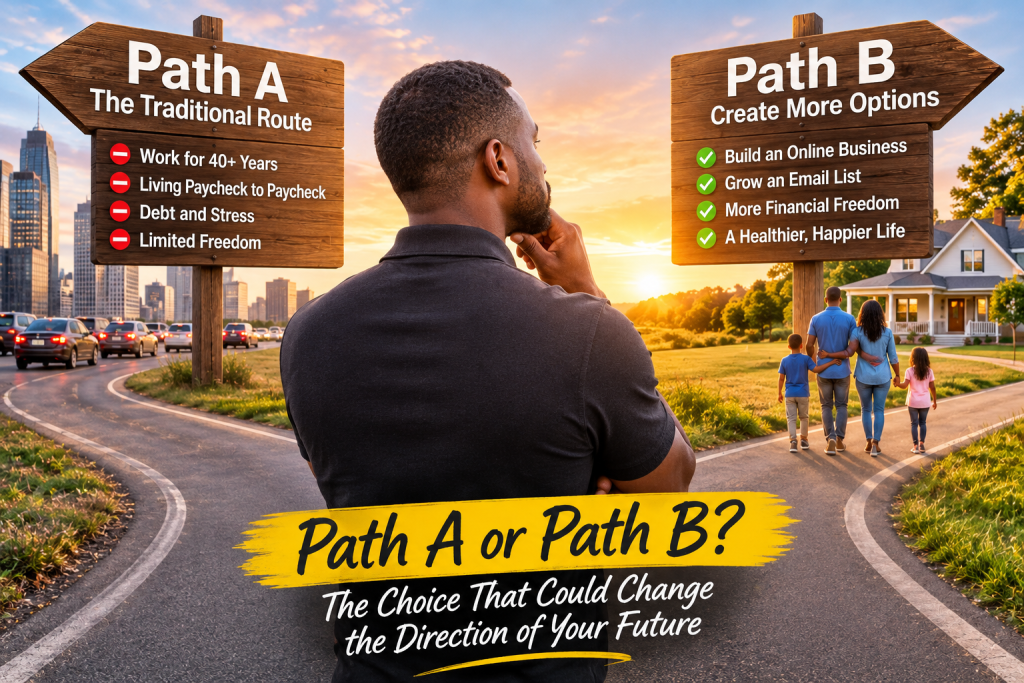
Path A or Path B? The Choice That Could Change the Direction of Your Future
Remember: You don’t have to change your entire life today. But you can make a decision today that starts moving you in a different direction.
The question isn’t simply Path A or Path B.
It’s this:
Are you happy to keep doing things the same way, or are you ready to explore what else might be possible?
If you keep doing what you’ve always done, where will you be five years from now?
It’s an interesting question, isn’t it?
Most people spend a large part of their lives following a path that society has taught them is the sensible thing to do.
Go to school.
Get a good job.
Work hard.
Pay your bills.
Raise a family.
Hopefully, retire comfortably one day.
There’s absolutely nothing wrong with having a job. Employment provides stability, structure and a regular income for millions of people.
But there’s another question worth asking.
What happens if your only source of income is the job you depend on?
What happens if you want more flexibility, more financial breathing room, or simply the ability to spend more time doing the things that matter?
That’s where the idea of Path A and Path B comes in.
Path A: The traditional route
Path A is the route most people know.
You work hard to build a career, earn a regular salary and gradually work your way through life.
Every month, money comes in.
Every month, money goes out.
Mortgage payments, rent, food, insurance, credit cards, family expenses and all the other costs that come with everyday life.
Before you know it, years have passed.
You might have changed jobs several times, worked countless overtime hours and postponed things you wanted to do because there simply wasn’t enough time or money.
And perhaps the biggest problem is that your income is still largely connected to your time.
If you stop working, your regular employment income generally stops too.
Of course, plenty of people build wonderful lives through traditional careers.
But relying on one income source can leave you with very few options when circumstances change.
And that’s something worth thinking about.
Path B: Creating another option
Now imagine approaching things differently.
Instead of relying entirely on your employment income, you decide to build something alongside it.
Something of your own.
An additional income stream that you can develop in your spare time.
You don’t have to quit your job tomorrow.
You don’t have to take unnecessary financial risks.
You don’t have to pretend that everything will change overnight.
You simply decide to start learning how to build an online business.
That might involve affiliate marketing, creating content, learning email marketing and building an audience.
The objective is to gradually create an asset that has the potential to generate income beyond your regular working hours.
And here’s where things get interesting.
You’re no longer just working for today’s paycheque. You’re also working towards building something that could benefit you in the future.
That is a very different way of thinking.
The biggest mistake people make when starting online
Here’s something that catches many beginners out.
They think making money online is all about finding a product, getting a link and posting it everywhere.
They send people directly to an affiliate offer.
Some people click.
Perhaps somebody buys.
But what happens to everybody else?
They disappear.
You’ve potentially paid for traffic, spent time creating content or worked hard to attract attention, but you haven’t built an ongoing relationship with those people.
This is where a better business model makes a difference.
Instead of focusing entirely on getting clicks, start thinking about building an email list.
Why?
Because your list is an asset.
When somebody joins your list, you have an opportunity to communicate with them again.
You can share useful information, answer questions, build trust and introduce relevant offers through follow-up emails.
And this is something many beginners overlook.
The money isn’t just in getting somebody to click. It’s in building a relationship and following up properly.
Traffic can come and go.
But an email list gives you something you can continue to build over time.
What if you could get paid while building your list?
This is one of the ideas that really changed how I look at affiliate marketing.
Traditionally, many beginners think they need to spend months building an email list before they can make anything from it.
But what if there was a model where you could work towards building your list while also promoting an offer that can generate commissions?
That’s the thinking behind The ClickBank Profit Club.
Rather than sending visitors straight to affiliate links and losing the lead, the model focuses on capturing leads, building your list and following up.
It combines:
-
Affiliate marketing.
-
Email list building.
-
Email follow-up.
-
Social media content.
-
A simpler approach to getting started.
-
A business model that doesn’t require you to create everything yourself.
You don’t need to invent your own product or build an entire business infrastructure from scratch.
You do need to learn, take action and remain consistent.
But having a clearer model to follow can make the starting point much less overwhelming.
You don’t need to become an expert overnight
One of the biggest reasons people never get started is that they think they need to know everything first.
They believe they need to understand websites, funnels, email marketing, automation, traffic generation and a dozen other things before they can take the first step.
No wonder so many people get stuck.
The truth is that you can learn these things gradually.
You don’t need to master everything on day one.
You need a sensible starting point, a model you understand and the willingness to keep learning.
That’s why experience matters when choosing who to learn from.
John Thornhill is a 9x ClickBank Platinum Vendor with more than 20 years of online experience. He has helped over 3,000 people since 2008.
His experience is behind the approach taught through The ClickBank Profit Club.
For beginners and affiliates who have tried different approaches without getting anywhere, learning from someone with an established track record can provide a much clearer direction.
Path B isn’t a guarantee. It’s a decision to create options.
Let’s be realistic.
Building an online business takes effort.
There are no guaranteed earnings, no magic buttons and no promise that you’ll replace your salary in six months.
Some people make progress quickly.
Others take considerably longer.
And some never achieve the results they hoped for.
But here’s what I believe is important.
You don’t have to accept that your current financial situation is the only possibility available to you.
You can learn new skills.
You can explore additional income opportunities.
You can build an email list.
You can develop an online asset.
And you can start taking steps towards having more choices in the future.
You don’t have to abandon Path A immediately.
You can start building Path B alongside it.
That might be the most sensible decision of all.
Path A is familiar.
Path B represents the possibility of doing something different.
One relies primarily on the traditional employment route.
The other involves learning to build an additional income stream and developing something you own.
Neither path guarantees a particular outcome.
But there is one thing worth remembering.
Time passes whether you take action or not.
Five years from now, you could be in exactly the same position, wishing you had started learning something new.
Or you could have spent those five years developing skills, building an email list and working towards a different financial future.
You don’t need to make a dramatic decision today.
You just need to decide whether you’re willing to explore another possibility.
Want to take a closer look at Path B?
If building an online business through affiliate marketing, list building and email follow-up sounds interesting, take a look at the opportunity here:
Discover the opportunity
See how the model works and whether it could be a suitable starting point for you.
Remember: You don’t have to change your entire life today. But you can make a decision today that starts moving you in a different direction.
The question isn’t simply Path A or Path B.
It’s this:
Are you happy to keep doing things the same way, or are you ready to explore what else might be possible?